
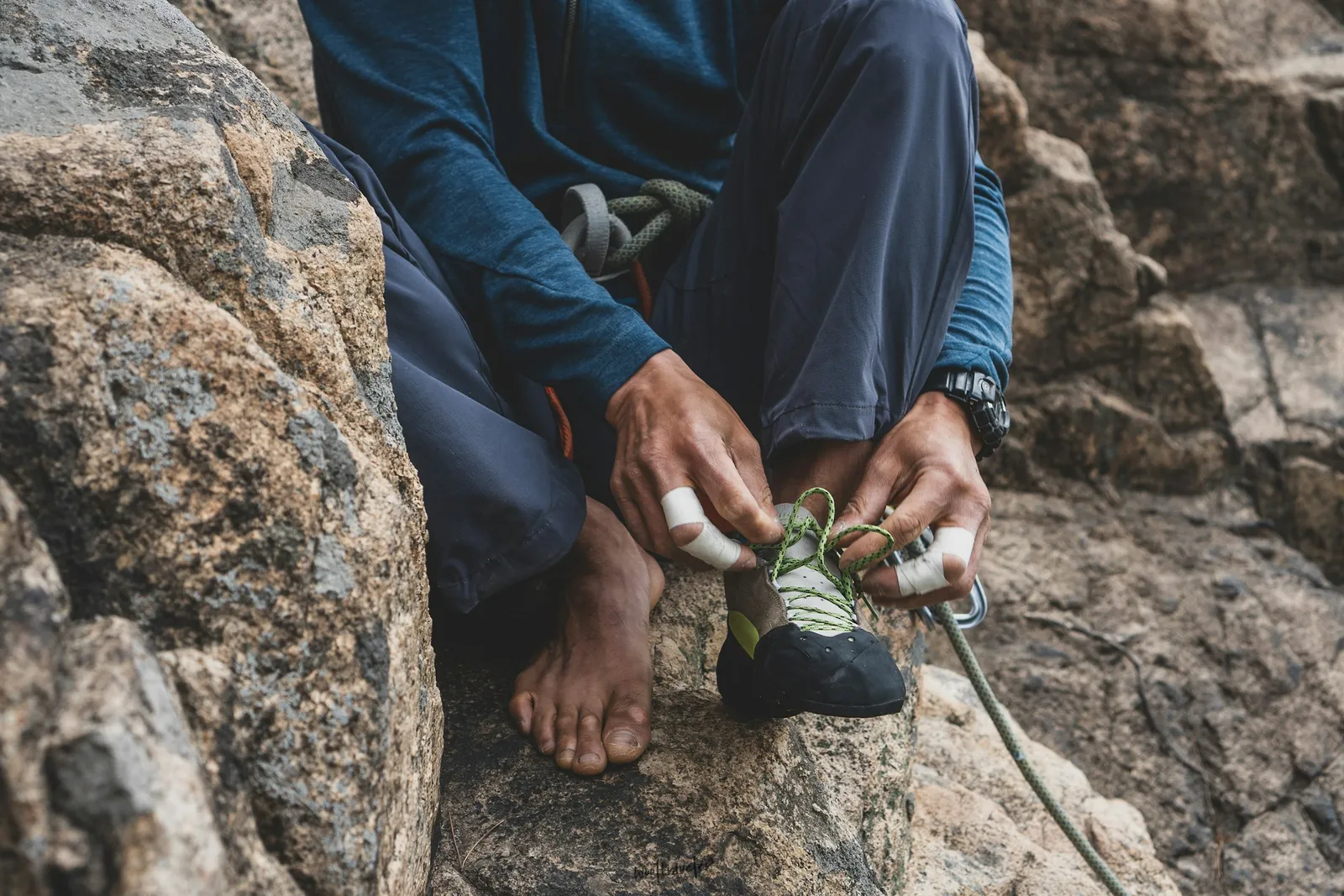
At my gym the finger ritual is settled. People hang from a board before they pull on anything hard, work through no-hangs, and take the first few problems below their limit. Nobody argues about it anymore.
Then the same climber sits down, pulls on the tightest shoes they own, and stands on a quarter-inch edge with toes that have done nothing all day.
The foot half of that ritual barely exists. It could: toe work fits between hangboard sets, and shoes can be bought to fit a foot rather than a shape climbers are told to aspire to. I made both changes years later than I should have, and the research below is why.
The research went to the hands
Climbing has produced a library on fingers. Pulley ruptures, lumbrical shift, load management protocols, graded return-to-climbing timelines. A climber with a sore A2 can find a rehab plan in an afternoon.
The feet got almost nothing, and the people who study this say so in print. The best review of climbing foot injuries opens by noting that reports on the lower extremity are rare, then calls it astonishing, given how many climbers turn up with foot problems.
Their explanation is honest. Finger injuries in climbers are new pathologies that nobody had described before, which makes them worth a journal's attention. Feet in climbing shoes are ordinary footwear damage at an unusual rate, which is not.
Ballet went the other way with the same problem. Dance medicine has prevalence studies running into the thousands of dancers, identified risk factors, and trials testing whether foot exercises change anything. Climbing has no equivalent of that last category at all.
The useful thing to take from ballet is not biomechanical. Pointe shoes and climbing shoes punish feet differently: a dancer wears hers for a class or a performance, gets fitted by a professional as a matter of course, and loads her foot straight down through the toes. You wear yours for hours of squeeze, fit them yourself, and buy them small on purpose. What ballet built around its punishing shoe was an infrastructure, professional fitting and a research literature. Climbing built neither, and passes its sizing advice around the gym instead.
What the shoe does while you stand in it
One measurement from a study of elite sport climbers stayed with me. Their big toes sat at fourteen degrees of drift barefoot. Inside the climbing shoe, the same toes measured twenty-one degrees.
The shoe bends the joint while you wear it, and those climbers spent around ten hours a week in that position. Most of them reported chronic foot problems, half had measurable bunions, and all of them had pressure marks over the big toe.
A separate survey of climbers found four in five reporting foot pain, a third with bunions, and two thirds getting numbness or tingling in their toes.
The finding I care about most as a practitioner comes from a more recent study comparing climbers against non-climbers. The climbers had lost about a quarter of their big toe extension, roughly fifty-four degrees against seventy in the control group.
That number matters more than it sounds. Your big toe extends every time you push off to walk. The motion tightens the tissue along the sole and turns your foot into a rigid lever you can leave the ground with. Lose the range and your ankle, calf, and Achilles take over a job they are not shaped for. I meet the result of that on my table often, in climbers who came to me about a calf or a knee.
Morton's neuroma comes up in every gym conversation about this. I cannot give you a number for climbers, because nobody has published one. The mechanism is established and the Mayo Clinic names rock climbing among the activities that contribute to it. That is as far as the evidence runs, and I would rather say so than invent a statistic.
Where the evidence stops
This literature is thinner than its circulation suggests, and those percentages get quoted everywhere as though they were settled.
The studies are small. Most are twenty-five years old. They looked mainly at elite men, they asked climbers to remember their own symptoms, and none of them followed anyone over time to see who ended up worse. Read the numbers as a direction, not as your odds.
One result complicates the story in both directions and rarely gets quoted. The survey that found all that foot pain also found no relationship between how far a climber had downsized and how much pain they reported. Tighter did not predict worse within that group. What the research supports is that climbing shoes as a category are hard on feet, not that every half size down costs you something measurable.
Two things you can do about it
The first is the shoe. Most climbers with sore feet get told to buy a more comfortable model, which sounds obvious and sends people straight into shoes that are flat, stiff, and still too narrow for the problem they have. Comfortable and wide describe different things, and the difference is worth understanding before you spend two hundred dollars.
The second is the warm-up. Your toes will do what you ask of them if you ask before you load them, and the foot work that fits between hangboard sets takes about as long as chalking up.
Soft, not tiny
The advice to buy two sizes down came from a constraint that stopped existing. Early technical shoes were unlined leather that stretched a full size or more, so climbers bought them small and let their feet finish the job. Modern synthetic uppers stretch close to nothing. The material changed and the habit outlived it.
The manufacturers have moved on. Evolv publishes three fit tiers for the Defy, and only the top one puts you at your street shoe size. Ocún tells beginners to start at their street size outright. The trend among strong climbers runs toward softer shoes rather than smaller ones, and toward owning a few pairs matched to the day.
I am not going to tell you that elite climbers all wear roomy shoes, because plenty of them downsize hard and Adam Ondra is the obvious example. The narrower claim holds up better anyway. Most of the climbing you do in a week does not need a performance fit. The researchers who reviewed climbers' feet recommend keeping a looser training pair for exactly that reason. And pain is information about a shoe, not the toll you pay for climbing hard.
Your feet hold you to the wall. They have earned the attention you already give your fingers.