
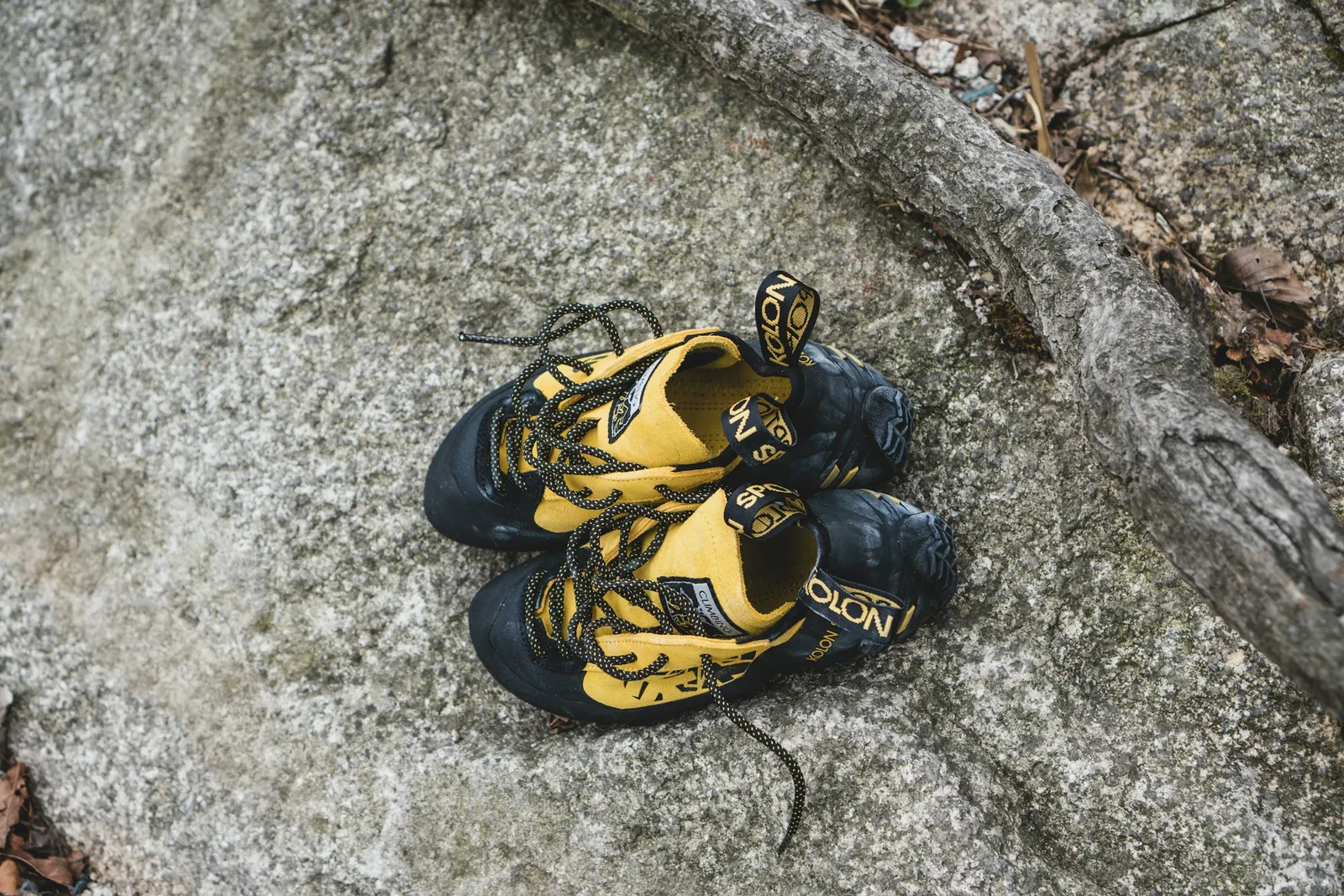
Tell a climber that your feet hurt and someone will name the La Sportiva TC Pro before you finish the sentence.
It deserves the reputation. The sole is flat, so your toes stay long instead of curling. It is stiff enough that your foot does not fatigue over a full day of pitches. The high top guards your ankles in cracks. For long days on rock, few shoes treat you better.
None of those qualities is width. La Sportiva describes the last as flat with medium asymmetry and makes no claim about width at all. Reviewers put it on the narrow side of medium. The 2021 redesign gave it a lower volume toe box rather than a roomier one, and the lace protectors press on higher volume feet.
So a climber with a bunion asks for help, follows the standard comfort advice, spends two hundred dollars, and ends up with pressure on the exact joint that started the conversation.
Six things people mean by fit
Climbers talk about fit as one axis running from painful to roomy. It is at least six, and they fail you in different ways.
Width across the forefoot. What most people mean by wide. Measured at the ball of the foot, where your metatarsal heads sit.
Volume. The height over your instep, which is separate from width. Plenty of climbers have a high volume narrow foot and buy the wrong shoe twice before working that out.
Toe box shape, and which toe the apex sits over. A shoe can be generously wide and still drive everything toward a point above your big toe.
Asymmetry. How hard the shoe pushes your big toe toward the others. This is the dimension nobody discusses and the one that matters most for a bunion.
Downturn. Changes where your toe pressure lands. It has nothing to do with room, though people treat aggressive and tight as the same word.
Upper material. Leather gives you half a size to a size as it moulds. Synthetic gives you close to nothing. A shoe that fits badly in synthetic will fit badly for its whole life.
What a bunion needs, and what a neuroma needs
These two problems send you looking for different shoes, and lumping them together as wide feet is how people end up disappointed. What follows is mechanism rather than a finding from a climbing study, since nobody has run that study.
A bunion is your first metatarsal drifting inward while the big toe angles out to meet the others. The joint between them pushes out on the inside of your foot. What it needs is low asymmetry and room on the medial side. A shoe that points everything at the big toe pushes the joint further along the path it already took, whatever the width label says. Leather helps here, because it moulds around the bump instead of pressing on it. Watch for a rand seam or a lace hook sitting over that joint.
A neuroma is a nerve getting compressed between the metatarsal heads, most often between the third and fourth toes. It needs transverse room across the ball of the foot so those bones stay apart, plus enough volume that the shoe is not squeezing the whole forefoot from every direction. A blunt toe box helps. A stretchy upper helps less, because the compression comes from the rand wrapping around you.
Where "size down two" came from
The rule made sense once. Early technical shoes were unlined leather that stretched a full size or more in the first month, so climbers bought them small and let their feet finish the shaping.
Modern synthetic uppers stretch close to nothing. The material changed and the advice stayed, passed climber to climber in gyms for twenty years after it stopped being true.
The manufacturers have already moved. Evolv publishes three fit tiers for the Defy, with your street shoe size at max performance, half to one full size up for performance, and one to one and a half up for comfort. Ocún tells beginners to start at their street size and sorts its models across narrow, regular, and high volume lasts. Butora sells the same model in labeled wide and narrow colorways, which is the most honest width marketing in the sport.
The industry is not uniform about it. La Sportiva still recommends going one to two European sizes down on the TC Pro, more for face climbing. Take the tier that matches what you are doing that day rather than the smallest number you can force your foot into.
Two shoes that solve different halves of it
The Evolv Defy is flat, neutral, and round through the toe box, closer to a street shoe than most people expect a climbing shoe to be. Sizing up into it is the simplest fix available to a wide forefoot.
It is also one of the cheapest shoes on the market, listing around a third below most performance models, and it wears TRAX SAS, the stickiest compound Evolv makes. That combination is unusual. The rubber under a wide, forgiving, inexpensive shoe is normally the place a manufacturer economizes, and here it is the same compound as on the shoes costing half as much again.
The cost is real and worth naming. The Defy is too soft and too wide to stand on small edges, which shows on steep technical footwork. Against that, most climbers spend far more hours in shoes than they spend on small edges. One warning: the synthetic upper does not stretch, so it fits when you buy it or it never will. Do not size down expecting the break-in that leather used to give you.
The Evolv Yosemite Bum answers the TC Pro question, and for a more specific reason than being the comfy one. Its toe box apex sits over the second toe rather than the big toe. A big toe that has already drifted needs that geometry; a big toe that has not needs it too, because nothing pushes it in the drifting direction for hours a week. Evolv labels it medium volume, so the advantage comes from shape rather than sheer room. The trade is torsional stiffness, and the thin upper hurts more in granite cracks than a TC Pro does.
I climb in both, which is how I know what each one costs.
The other twelve hours
Climbing shoes take the blame in every conversation about climbers' feet, and they are on your feet for a few hours a week. Your street shoes are on for most of your waking life, and a great many of them taper to a point well inside the width of the foot standing in them.
A bunion does not arrive from one source. If the shoes you walk around in all day squeeze the same joint your climbing shoes squeeze, changing only the climbing pair addresses the smaller share of the load.
This is the change I made first, and I made it as prevention rather than repair. My toes have not drifted, and moving into barefoot-style shoes with a foot-shaped toe box in daily life is the cheapest available way to keep it that way. The climbing shoes followed the same logic afterward.
Prevention is the easier side of this problem by a wide margin. The exercises in the foot work post manage a bunion and cannot straighten one, and the same asymmetry runs through everything else here: a toe box that never pushed your joint sideways beats any amount of work undoing it later.
Other shoes worth trying on
Read this as a starting list for the shop, not a ranking. No brand publishes last widths in millimeters, so every claim below comes from a manufacturer fit label or a reviewer's feet.
Gym, beginner, and all-day comfort: Evolv Defy, La Sportiva Tarantulace, Scarpa Origin, Butora Endeavor 2.0 in the wide colorway, Unparallel UP Lace.
Bouldering and performance on a wider last: Scarpa Instinct VSR, Scarpa Veloce for its blunt rounded toe, Butora Acro in wide.
Trad, crack, and long days: Scarpa Generator Mid, which reviewers name as the wider alternative to the TC Pro and which comes in mid and low tops, and the Evolv Yosemite Bum.
Brands that shape lasts around feet: Ocún markets an anatomically shaped front on several models, Butora labels width outright, and Red Chili publishes a foot shape guide.
The two-pair habit
If you take one thing from this, take this one. Keep two pairs.
A fitted pair for your project, and a roomy pair for warm-ups, volume days, and everything at the gym. The researchers who reviewed climbers' foot injuries recommend it in the conclusion of their paper, telling climbers to avoid over-tight shoes and keep a loose fit training shoe alongside them. It is the rare piece of climbing foot advice with a citation behind it.
Buy shoes in the afternoon when your feet have swelled, bring the socks and the spacers you climb in, and walk around. If a shop lets you hang on a wall for a few minutes, take that offer.
Your foot, not anyone else's
Every model named here suits a particular shape, and none of them is a recommendation for a foot I have not seen. Wide is wrong for a narrow foot. A blunt toe box wastes space if yours comes to a point at the big toe. The Defy is a poor choice for someone who mostly stands on small edges and has no width problem to solve.
Buy and climb in the shoes that suit your foot shape and what you climb. What the research argues against is one habit: choosing a shoe by how small you can get it rather than by how it is shaped. That habit fits nobody, including the climbers it is supposed to be making faster.
The research on what tight shoes do to feet over years sits in its own post. If your feet already hurt, the foot work is worth starting before the new shoes arrive.